by Pier Paolo Maccarrone
Gabriel Fauré’s Élégie, Op. 24, for cello and piano: history, stylistic analysis, and listening guide.
Élégie op. 24 di Gabriel Fauré per violoncello e pianoforte: storia, analisi stilistica e guida all’ascolto.
🎼 Introduzione e contesto storico
Gabriel Fauré compose l’Élégie in do minore op. 24 nel 1880, inizialmente come movimento lento di una sonata per violoncello e pianoforte che non fu mai completata. Il brano venne pubblicato nel 1883 come pezzo autonomo e riscosse subito grande successo. Nel 1895, su richiesta del direttore Édouard Colonne, Fauré ne realizzò una versione orchestrale, eseguita per la prima volta nel 1901 con Pablo Casals come solista.
L’opera è dedicata al violoncellista Jules Loëb, e rappresenta uno degli ultimi esempi di espressione romantica diretta nella musica di Fauré. Dopo questa composizione, il suo stile si fece più introverso e raffinato.
🎼 Introduction and Historical Context
Gabriel Fauré composed the Élégie in C minor, Op. 24, in 1880, initially as the slow movement of a never-completed sonata for cello and piano. The piece was published in 1883 as a standalone piece and immediately enjoyed great success. In 1895, at the request of conductor Édouard Colonne, Fauré created an orchestral version, which was premiered in 1901 with Pablo Casals as soloist.
The work is dedicated to cellist Jules Loëb and represents one of the last examples of direct Romantic expression in Fauré’s music. After this composition, his style became more introverted and refined.
🎻 Analisi stilistica
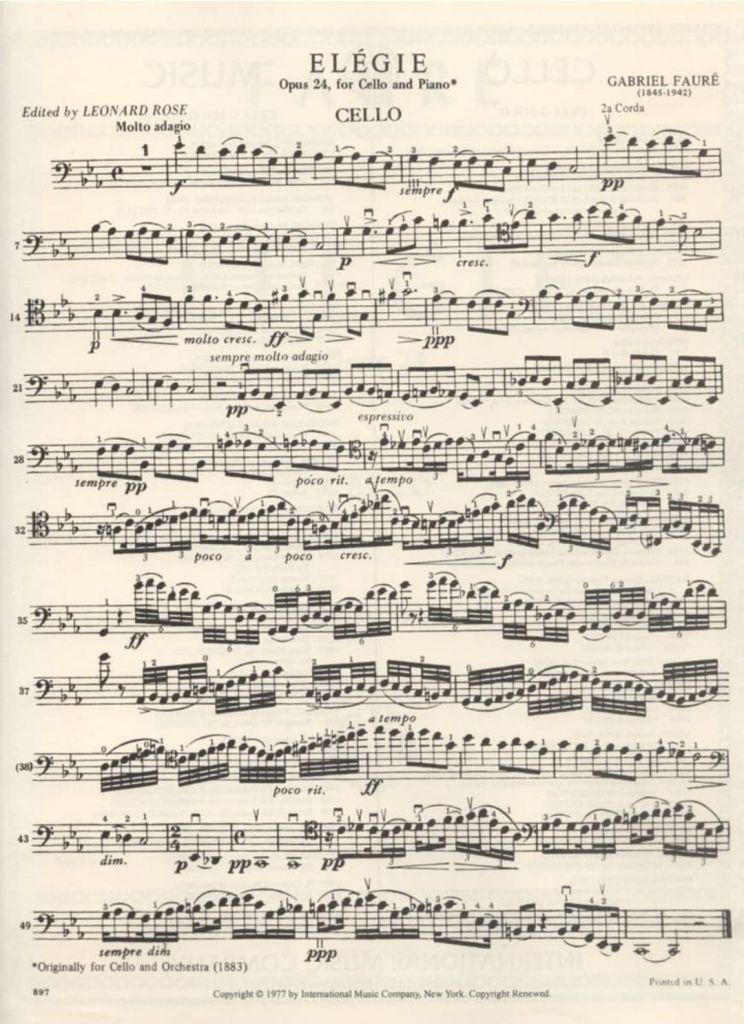
L’Élégie è un brano breve (circa 6-7 minuti), ma intensamente espressivo. La forma è ternaria ampliata (AABA CC Trans-D AC’C’ + coda), con ritorni tematici e contrasti dinamici ben calibrati.
🎻 Stylistic Analysis
The Élégie is a short piece (about 6-7 minutes) but intensely expressive. Its form is an expanded ternary (AABA CC Trans-D AC’C’ + coda), with thematic returns and well-calibrated dynamic contrasts.
Caratteristiche principali:
– Tonalità: Do minore, che contribuisce al carattere elegiaco e malinconico.
– Tema iniziale: Il violoncello espone una melodia lunga e dolente, sostenuta da accordi ribattuti del pianoforte, quasi come rintocchi funebri.
– Sezione centrale: Più dolce e cantabile, con il pianoforte che prende il tema e lo avvolge in arpeggi. Culmina in una cadenza drammatica.
– Ritorno: Il tema iniziale riemerge, ma con variazioni ritmiche e dinamiche che ne intensificano l’effetto.
– Coda: Il brano si spegne lentamente, lasciando un senso di quiete e contemplazione.
Fauré bilancia il lirismo con una sobrietà tipicamente francese, evitando eccessi romantici e mantenendo un controllo formale rigoroso.
Key Features:
– Key: C minor, which contributes to the elegiac and melancholic character.
– Opening Theme: The cello presents a long, mournful melody, supported by repeated piano chords, almost like funeral tolls.
– Middle Section: Softer and more lyrical, with the piano taking the theme and wrapping it in arpeggios. It culminates in a dramatic cadence.
– Return: The opening theme resurfaces, but with rhythmic and dynamic variations that intensify its effect.
– Coda: The piece slowly fades away, leaving a sense of quiet and contemplation.
Fauré balances lyricism with a typically French sobriety, avoiding romantic excesses and maintaining rigorous formal control.
🎧 Ascolto guidato
1. 0:00 – Introduzione
Il violoncello entra con un tema grave e solenne. Invita a riflettere sul significato della parola “elegia”: un lamento, una commemorazione.
2. 1:30 – Crescita emotiva
Il dialogo tra violoncello e pianoforte si intensifica. Chiedi di notare come il pianoforte non accompagni passivamente, ma dialoghi attivamente.
3. 2:30 – Sezione centrale (maggiore)
Il clima cambia: il tema è più dolce, quasi consolatorio. Invita a immaginare un ricordo felice che interrompe il dolore.
4. 4:00 – Cadenza drammatica
Il violoncello esplode in una frase veemente. Chiedi di osservare il contrasto con l’inizio e come questo momento rappresenti un culmine emotivo.
5. 5:30 – Ritorno e dissolvenza
Il tema iniziale ritorna, ma più quieto. Il brano si spegne lentamente. Invita a riflettere sul concetto di accettazione e pace.
🎧 Guided Listening
1. 0:00 – Introduction
The cello enters with a grave and solemn theme. It invites reflection on the meaning of the word “elegy”: a lament, a commemoration.
2. 1:30 – Emotional Growth
The dialogue between cello and piano intensifies. Ask the listener to notice how the piano does not passively accompany, but actively engages in dialogue.
3. 2:30 – Middle Section (Major)
The mood changes: the theme is softer, almost consoling. It invites the listener to imagine a happy memory interrupting the pain.
4. 4:00 – Dramatic Cadence
The cello explodes into a vehement phrase. Ask the listener to notice the contrast with the beginning and how this moment represents an emotional climax.
5. 5:30 – Return and Fade
The opening theme returns, but more quietly. The song slowly fades out. It invites reflection on the concepts of acceptance and peace.
📚 Conclusione
L’Élégie di Fauré è un perfetto esempio di come un brano breve possa racchiudere un mondo emotivo complesso. È ideale per introdurre gli studenti alla musica romantica francese, alla forma ternaria e all’arte del fraseggio espressivo.
📚 Conclusion
Fauré’s “L’Élégie” is a perfect example of how a short piece can encompass a complex emotional world. It’s ideal for introducing students to French Romantic music, ternary form, and the art of expressive phrasing.
 Pier Paolo Maccarrone